Revitalising the 5 Ws in secondary English
When oral presentations terrify middle schoolers, here's how I used the I Do / We Do / You Do model and the 5 Ws to create a managable task.


It seems to be any Year 8's nightmare: the oral presentation. Stand up in front of the class and read what you wrote aloud.
It's exactly what I asked my students to do this term.
I Do (Who, What, When, Where, Why)
The task? 30 seconds talking about something in front of the class. As I work in a low SES school, the bar for these students, while not low, is perhaps lower than I'd personally prefer.
Many of them started quaking in their seats at the mention of having to write a 30-second presentation. Even without gradual release principles, it was clear I needed to provide what 30 seconds actually looked like before I had them give it a go.
If our first oral presentation for the term was going to be about something relatively mundane about their personal lives. My example was why Final Fantasy XV is my favourite video game. I have students with the dreaded head-empty syndrome, so the scaffolds went back to basics. "Gather around, students, for I shall spend the next five minutes writing a brief 30-second oral presentation in front of you!" I plugged the laptop into the television and described how to write an oral presentation while doing it directly in front of them. The intention was to show that this task was not as enormous as they may have feared.
The 5 Ws are the base of any self-respecting writer's works, even if they're no longer conscious of doing it. Who, what, when, where, why are the five dot points students need to fill out about their oral presentation. They've already got the who down (the who being you).
(Having applied the 5 Ws in class, I've decided the order should actually be what, who, when, where, why, purely because both my students and I often stumbled between prioritising the what over who.)
We Do (Expansion)
This is the opportunity to get students involved in expanding these dot points as a class. If what is Final Fantasy XV, and who is me, then our opening sentence is "Today I'll be talking about why Final Fantasy XV is my favourite video game." Then we add when: "I got Final Fantasy XV in 2018, a few years after it originally released." If where is at home and on my PlayStation, the sentence becomes, "I bought it for Playstation 4, which I have at home." If the why is because it looked cool, then the sentence becomes, "I bought it because I liked the cover--it's four guys standing around a cool-looking convertible in an open expanse of land."
As a class, we came up with:
Today I'll be talking about why Final Fantasy XV is my favourite video game. I got Final Fantasy XV in 2018, a few years after it originally released. I bought it for PlayStation 4, which I have at home. I liked the look of the cover--there are four guys standing around a cool-looking convertible in an open expanse of land.
Hey look, guys! We wrote a paragraph!
And everybody clapped. (Sadly, nobody clapped.)

The point is, I feel we need to re-prioritise the 5 Ws. Now that my paragraph has the basic information down, we can use that as the base for more information. What happens in the video game? Who else do I know enjoys it? When did I finish it? Where can people buy it now? Why is it still my favourite video game? You and students can create an infinite number of context-related open-ended questions based on the 5 Ws. And that's without mentioning how.
You Do (Writing their presentation by hand)
If a student cannot read their own notes, then what is the point of writing them? For example, when I write quickly, it tends to be illegible to even myself.
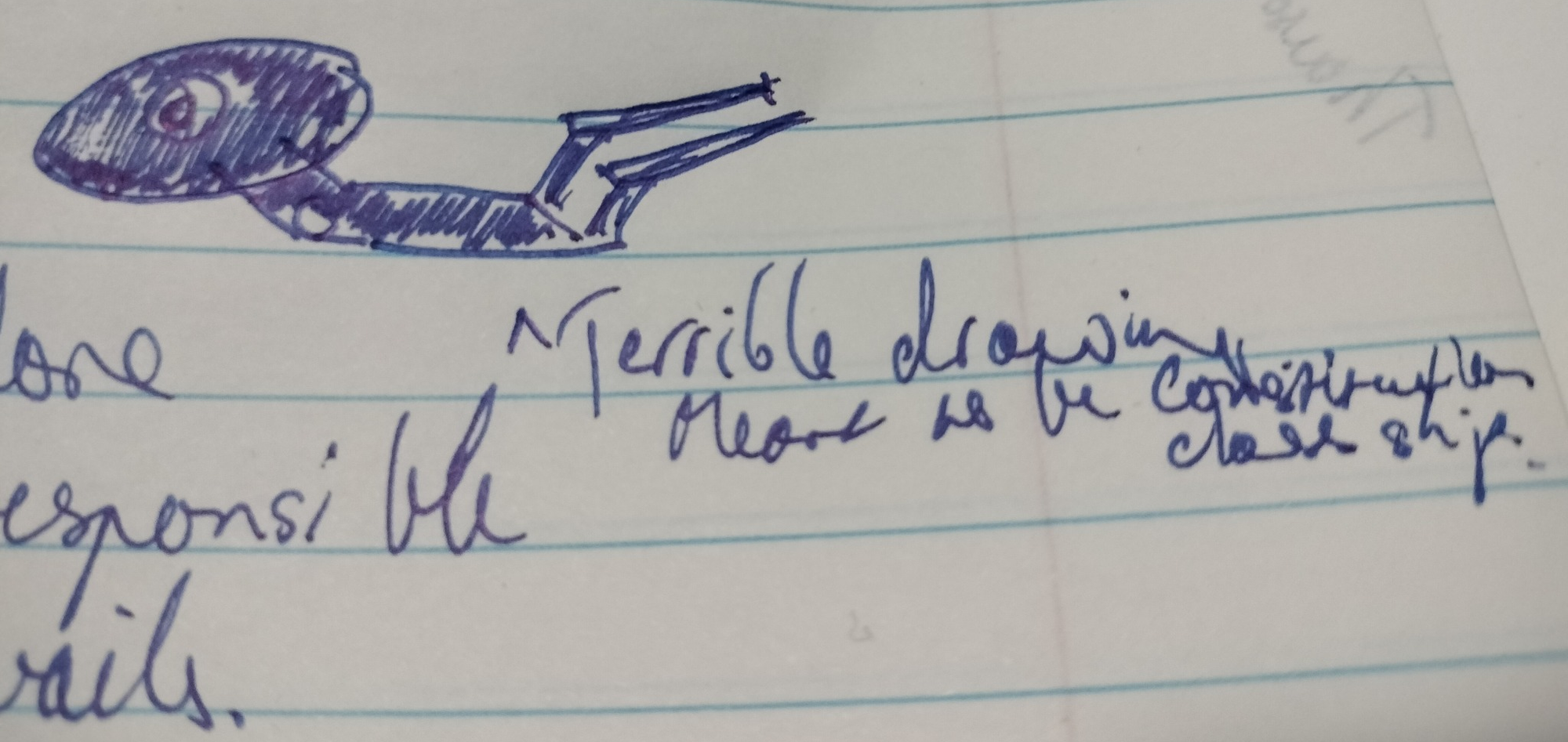
This is not the case when I'm writing carefully, however.
There are only a few students I think should be allowed to write their oral presentation on their devices: those who have few other, or no other, options. I'm a firm believer in tactile, hand-written notes coding information far better than keystrokes on a computer. My evidence at the moment is purely anecdotal (I did, therefore I know). There have been attempts to recreate Mueller and Oppenheimer's 2014 study The Pen Is Mightier Than the Keyboard (where long-hand note-taking students performed better than keyboard note-taking), and they have had mixed results. Regardless, my reasons for making students handwrite their speeches--when the student does not require differentiation--is because of the need to learn how to a; write carefully for the purposes of reading aloud or other people to read their handwriting, and b; verbally structure writing.
There is a difference between writing for reading and writing for reading aloud, however minute. For inexperienced writers, lumping a paragraph together and then reading it aloud on the spot is not feasible. The trick is to space out writing for easier reading-aloud, so not to get lost in the middle of the massive paragraph while many are watching. There's a reason we all like scrolling teleprompters.
30 seconds of their lives they think they'll never get back, twenty minutes of mine I'm proud to have experienced.
The intention was to ensure they could at least get up in front of their classmates and read aloud. I'm proud to say that every single one of them managed that! Those who shivered their timbers I had present privately to me--and I do have some thoughts on one particular case I'd like to share--but across the board, all were glad they got their short speeches over and done with.
The first oral presentations were brief exercises designed to get them up. The next presentation is about a set topic they'll have to research on their own. And the third will be longer than 30 seconds. I'm excited. I'm proud to see them perform well in the classroom.